
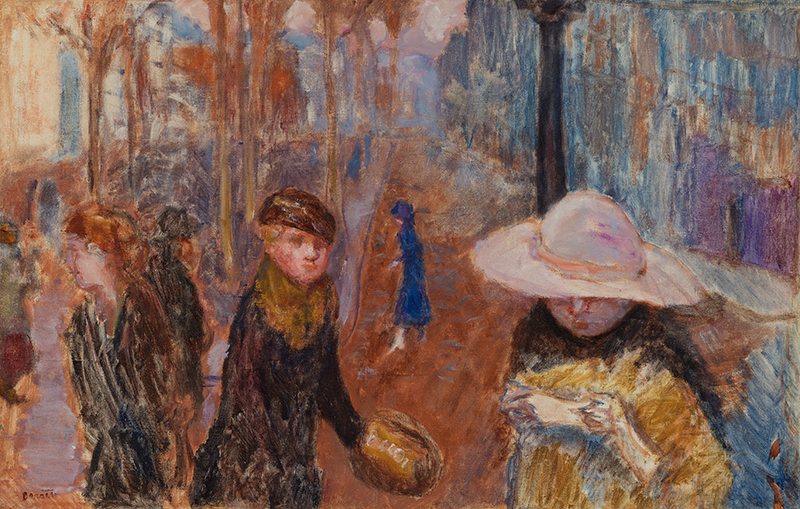
Promenade à Paris, circa 1911
Oil on canvas, estate stamp (Lugt 3886) lower left.
40 x 60 cm
Provenance:
Estate of Pierre Bonnard
Bowers sisters collection
Collection of Pierre and Marie-Françoise Vernon
Literature:
Jean and Henry Dauberville, Bonnard, vol. IV, Paris, Bernheim-Jeune, 1974, illustrated p. 312, no. 01992.
Exhibitions:
Pierre Bonnard, Royal Academy of Arts, London, 6 January – 13 March 1966, no. 135 (titled Street Scene and dated 1917–1920).
Pierre Bonnard, A. Tooth & Sons, London, 17 June – 12 July 1969, reproduced in the exhibition catalogue under no. 8 (under the title Figures in the Street and dated circa 1922–1925).
Matisse e Bonnard. Viva la pittura!, Rome, 2006, reproduced in the exhibition catalogue (ed. Skira), p. 340, no. 125.
Bonnard, Le Cannet, une évidence, Musée Bonnard, Le Cannet, 2020, reproduced in the exhibition catalogue, p. 42.
Amitiés, Bonnard–Matisse, Fondation Marguerite et Aimé Maeght, Saint-Paul-de-Vence, 29 June – 6 October 2024, reproduced in the exhibition catalogue, full page, p. 91.
The construction of this work by Pierre Bonnard recalls that the artist was also a photographer, experimenting with bold framing. Although his painting captures the instant, it has nothing in common with the tentative realism of early twentieth-century photography. Composed entirely of colour and sensation, it constructs a fragile world of subtle harmony.
Just before committing himself to the South, before unleashing the brilliance of Mediterranean light in colour across his canvases, Bonnard explored the mechanisms of a more subdued sensuality in the early 1910s, while occupying a studio in the capital, not far from the avenue depicted here. The “very Japonard Nabi,” as he was nicknamed by his youthful companions in the group, knew how to summon on the canvas the colour of a murmur, the secret of a letter.
On one side of the painting, cool tones—juxtaposed blues and violets—stand in opposition to the russet hues of this autumnal Parisian avenue, bringing forth in the foreground, beneath a hat bathed in light like a reinvented halo, the bowed face of a reader. Her eyes are hidden from us, absorbed in her reading. Although she has removed her gloves, she likely no longer feels the sharp cold of this November afternoon. Elegant silhouettes glide through the landscape; yet they endure, together with this heroine in the hat, on our retina and in our memory, like accomplices in a shared intimacy—the duration of a love letter.
This painting, unpublished on the art market since the 1960s, has been included in several museum exhibitions, most recently in 2024 at the Fondation Maeght, Saint-Paul-de-Vence.